
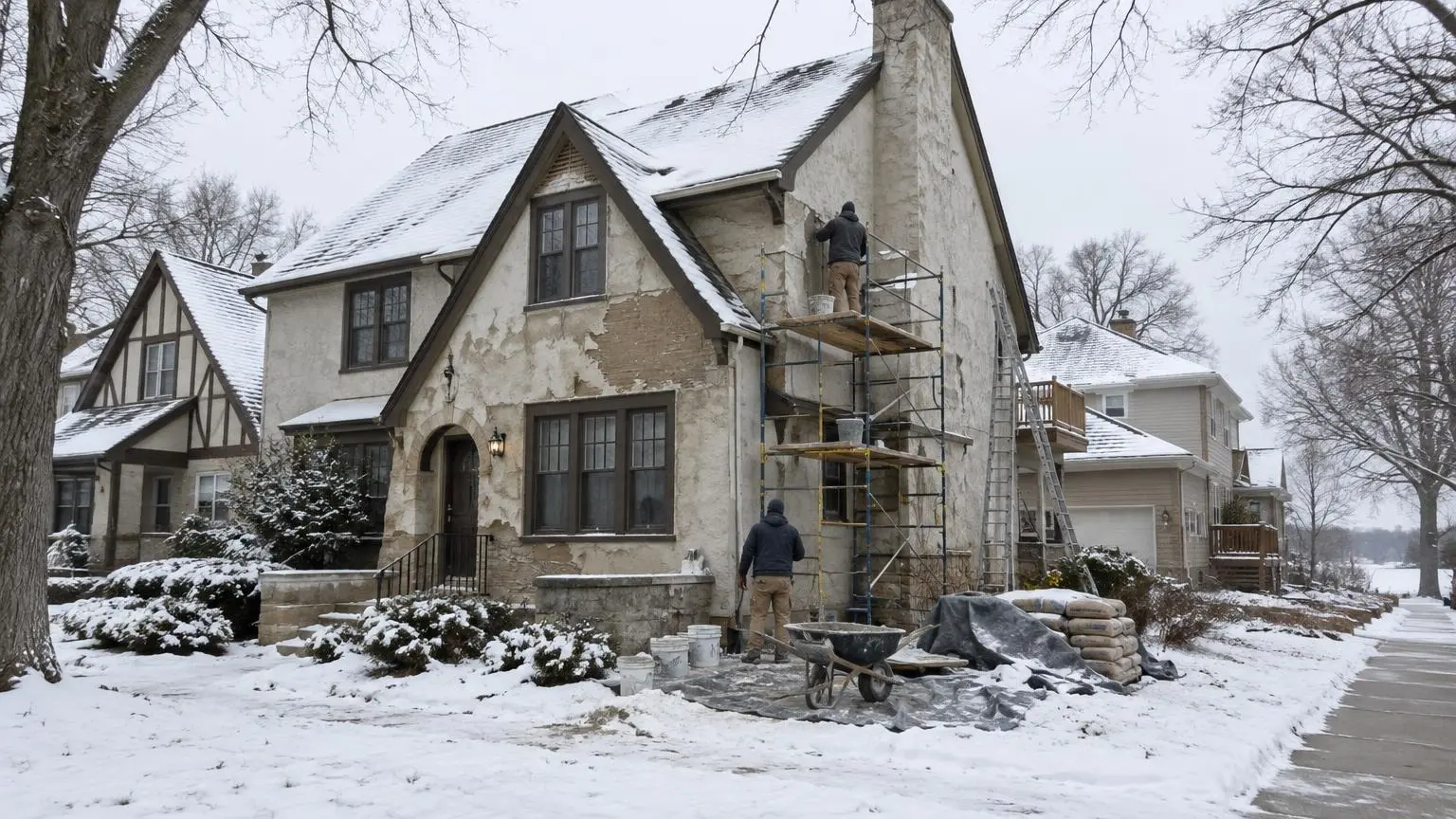
Minnesota's 7th-largest city, mostly built after 1970
Stucco Repair in Plymouth, MN
We trace stucco leaks to where they start: window corners, deck ledgers and roof-to-wall joints, then fix the flashing along with the finish.
- Free on-site estimates
- Written, itemized quotes before any work
- Cause of the damage found before patching
Plymouth Homes and the Four Places Stucco Leaks
If you are looking for stucco repair in Plymouth, there is a good chance your house was built during the decades the city grew fastest. Plymouth went from 18,077 residents in 1970 to 50,889 in 1990 and 65,894 in 2000. That growth overlaps the years when Minnesota builders produced many stucco homes that later had serious moisture damage. The good news is that the causes are well documented, so we know where to look.
What the Woodbury study found
The City of Woodbury tracked every one of its 670 stucco homes from 1999 onward. By February 2011, 451 of them, or 67%, had failed and been repaired, on average 9.9 years after they were built. The city pointed to four primary causes: window leaks, missing kickout flashing, improper deck flashing and grade above the wood framing. Woodbury is not Plymouth, but the builders, methods and materials of that era were used across the metro. Those four points are where we start on any Plymouth home of the same vintage.
1. Windows
Water that gets past a window frame runs down inside the wall, behind the stucco, where nobody sees it. Typical signs are stains or soft drywall below a window inside, or cracks running from the lower corners outside. We check the sill and jamb flashing and the sealant joints, and we test the sheathing below the corners.
2. Roof lines that end at a wall
Where a lower roof edge runs into a stucco wall, rain pours off the roof right onto the wall unless a kickout flashing turns it away. Without one, the wall below often rots in a fan shape. Minnesota now requires kickout flashing whenever a home is re-sided, so it becomes part of any repair we do in that area.
3. Decks
A deck ledger bolted to the house through stucco needs flashing above it. Without it, water collects behind the ledger and soaks into the rim and sheathing. Since decks are common on Plymouth homes, we look closely at that joint.
4. Grade and landscaping
When soil, mulch, pavers or a patio slab sits at or above the bottom of the stucco, the wall wicks water upward into the framing. Raising garden beds over the years can create this problem slowly. We measure clearances and suggest changes to the grade as part of the repair.
How a repair goes
- Find it: probe testing at the four high-risk locations, with readings recorded by spot.
- Open it: remove stucco in the affected area to see the full extent.
- Fix the cause: new flashing at windows, kickouts, ledgers or grade, not just new stucco.
- Rebuild: replace damaged sheathing, install a weather-resistive barrier and lath, and apply new stucco in layers.
- Match: finish coat textured and colored to blend with the rest of the house, or a full recoat for a uniform look.
When sheathing comes off, Minnesota's re-siding rules require a building permit, replacement of rotted sheathing and framing, and inspections of the barrier and flashing before the wall is closed. We arrange those inspections with the city as part of the job.
Plymouth-specific planning
If your Plymouth neighborhood has a homeowner association, it may have rules about exterior colors and contractor hours. If you plan to change your color while we recoat, check with your association first. We can give you a written scope to send in.
Call (612) 482-6637 to talk through what you are seeing.
Facts That Matter for Plymouth Stucco
- Most growth after 1970. Plymouth incorporated as a village on May 18, 1955. Its population went from 18,077 in 1970 to 50,889 in 1990 and reached 81,026 in the 2020 census, making it Minnesota's 7th-largest city.
- Four main leak points. Woodbury's study of 670 stucco homes named window leaks, a lack of kickout flashing, improper deck flashing and grade above the wood framing as the primary causes of damage; 67% of those homes had failed and been repaired by 2011.
- Kickout flashing required. Minnesota's re-siding fact sheet says kickout flashings shall be installed when re-siding, along with flashing at windows, doors and deck attachments, and requires a weather-resistive barrier and flashing inspection.
- Owners who stay. Census estimates for 2020 to 2024 show 75.1% of Plymouth homes are owner-occupied, the median owner-occupied value is $491,200, and 88.9% of residents lived in the same house a year earlier.
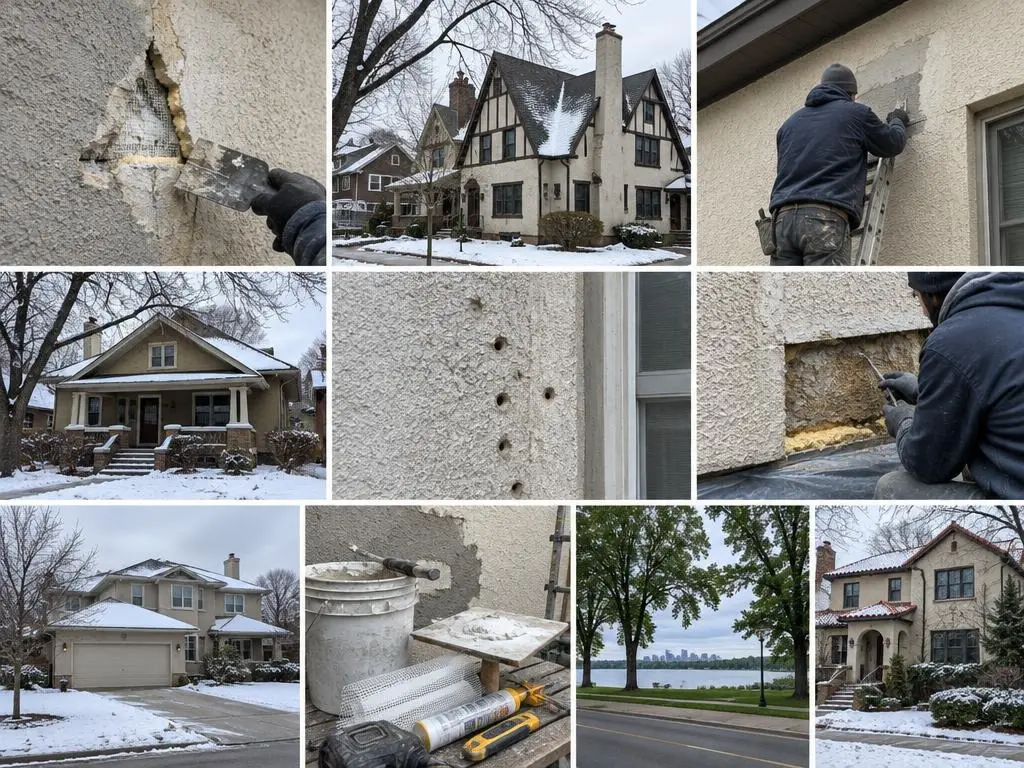
Plymouth Questions
My Plymouth house was built in the early 1990s. Should I be worried?
Not worried, but informed. Homes from the late 1980s through 1999 were built during the period when many Minnesota stucco walls trapped water. A probe test at the windows, roof-to-wall joints and deck gives you a clear answer either way.
What is a kickout flashing and do I need one?
It is a small, angled piece of metal at the bottom of a roof edge where it meets a wall, which turns runoff away from the stucco and into the gutter. If any lower roof on your house dies into a stucco wall without one, that wall section is at risk. Minnesota requires them when a wall is re-sided.
Can't you just patch the stucco where the stain is?
A patch over a leak will leak again. We find where water is getting in, fix that flashing or grade problem, replace any damaged sheathing and then rebuild the stucco. It is more work up front but it is the repair that lasts.
Does my HOA need to approve a stucco repair?
A like-for-like repair usually is not an issue, but a color change during a recoat often needs approval. Check your covenants and send the association our written scope.
Free Estimates in Plymouth, MN
Free stucco leak inspections and estimates in Plymouth.
Stucco Repair Near Plymouth
- Stucco Repair in Minneapolis, MN
- Stucco Repair in Saint Paul, MN
- Stucco Repair in Edina, MN
- Stucco Repair in Bloomington, MN
- Stucco Repair in Richfield, MN
- Stucco Repair in St. Louis Park, MN
- Stucco Repair in Minnetonka, MN
- Stucco Repair in Golden Valley, MN
- Stucco Repair in Maple Grove, MN
- Stucco Repair in Brooklyn Park, MN
- Stucco Repair in Roseville, MN
- Stucco Repair in Eden Prairie, MN
- Stucco Repair in Woodbury, MN
- Stucco Repair in Eagan, MN
- Stucco Repair in Burnsville, MN
- Stucco Repair in Wayzata, MN
- Stucco Repair in Shoreview, MN