
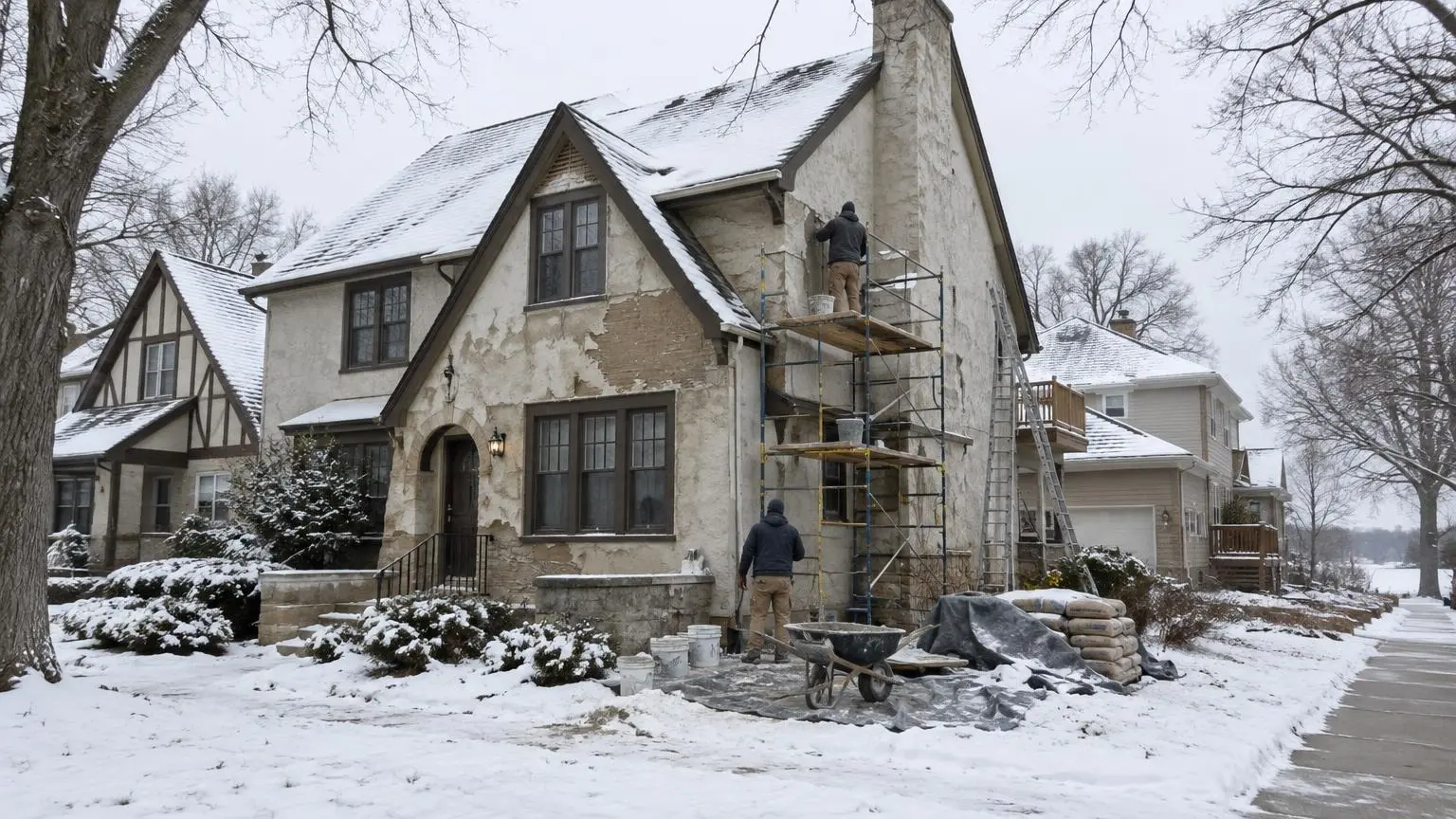
Home base: a city where 43.7% of housing predates 1940
Stucco Repair in Minneapolis, MN
Patching, moisture testing and restoration for Minneapolis walls that have been through decades of hard freezes, from 1920s bungalows to stucco built in the 1990s.
- Free on-site estimates
- Written, itemized quotes before any work
- Cause of the damage found before patching
Our Home City, and Its Old Walls
Stucco repair in Minneapolis starts with one question: how old is the wall? This is where we are based, and and much of the housing here is old. According to Wikipedia's summary of census data, 43.7% of housing units in the city were built in 1939 or earlier. A large share of the stucco we see on Minneapolis streets is original to that era, and it behaves differently from the cement stucco put on suburban houses fifty years later. Getting the repair right means reading the wall before mixing anything.
What the prewar stucco is made of
The National Park Service's Preservation Brief 22 explains that stucco was tied to bungalows, four-square houses, Tudor Revival and Mediterranean-inspired homes from about 1890 into the 1930s and 1940s. Before the late 1800s stucco was mainly lime-based; portland cement became common after about 1900, but some plasterers kept using lime. That matters because, as the same brief puts it, portland cement is rigid and incompatible with early, softer lime-based stucco. The two expand and contract at different rates, so a hard patch set into a soft wall often cracks around its edges and lets water in. On an older Minneapolis house we check the binder first, then choose a mix that moves the way the original wall moves.
The winter test every wall takes
The January daily mean at the Minneapolis-Saint Paul airport is 16.2°F, with a mean daily low of 8.8°F (1991-2020 normals), and the city averages about 51.2 inches of snow a year. Snow piled against a foundation melts on a sunny afternoon, soaks into any open crack, and freezes again at night. Over a few winters a hairline crack turns into a loose section. That is why we would rather seal a small crack in the fall than rebuild a panel in the spring.
How we approach a Minneapolis repair
- Look before we cut. We walk the whole exterior, note cracks, stains, bulges, loose trim and failed caulk, and map where water is likely getting behind the stucco.
- Match the old mix. For prewar walls we identify whether the stucco is lime-rich or portland-based and use a compatible mix rather than a hard modern patch.
- Match the finish. Preservation Brief 22 notes that the finish coat should be worked to match the texture of the original. Heavily textured walls hide patches well; smooth walls usually need a color coat or paint to blend.
- Follow the scoring. On scored stucco we square off a patch along the existing lines so it reads as part of the wall.
- Work in the right weather. The NPS guidance is to avoid applying stucco below 40°F, and preferably warmer, or when frost is likely. We schedule exterior stucco work for the months that allow it.
Newer Minneapolis homes and moisture testing
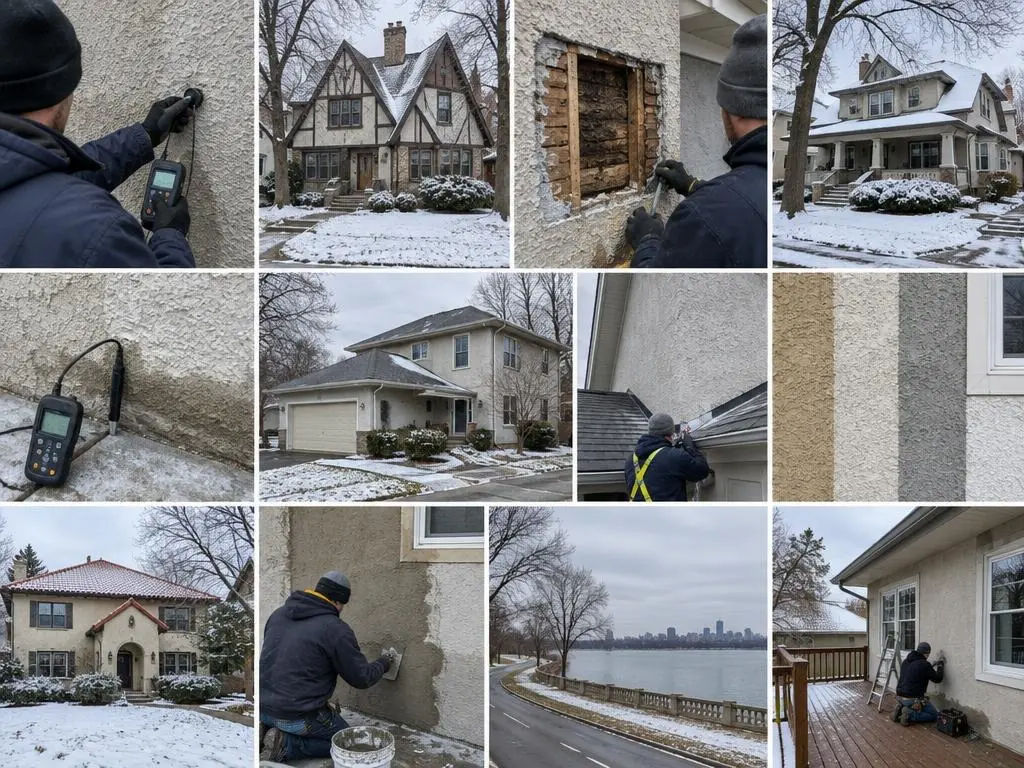
Not every Minneapolis stucco house is a century old. Infill homes and remodels from the late 1980s and 1990s were built in the same period that produced Minnesota's well-documented stucco failures. The City of Woodbury's position paper on stucco in new residential construction found that 451 of the 670 stucco homes in that city (67%) had failed and been repaired by February 2011, on average 9.9 years after construction. The main causes were window leaks, missing kick-out flashing, improper deck flashing and grade above the wood framing. If you own, are buying or are selling a Minneapolis stucco house from that era, invasive moisture testing is the way to find hidden damage before it spreads.
Historic districts and city permits
Minneapolis has more than 150 individual properties designated as local landmarks and twelve locally designated historic districts, according to the city's guide to heritage preservation. In those areas, limited masonry and siding repair is treated as a minor alteration reviewed by city staff, while larger changes can go to the Heritage Preservation Commission for a public hearing. Outside the districts, the city's building bulletin on windows and doors states that building permits are required when alterations are made to exterior walls. We confirm with the city what applies to your job before work starts, and if a permit is needed we build that time into the schedule.
Services we offer across the city
- Stucco crack repair and patching on houses, garages and porches
- Invasive moisture testing and remediation of wet sheathing
- Recoating and new color coats to refresh faded or patched walls
- EIFS repair where synthetic stucco is present
- Historic stucco restoration with lime-compatible mixes
- Flashing and sealant corrections at windows, decks and roof lines
Getting a written estimate
Call (612) 482-6637 or send photos of the area that worries you. We look at the wall in person, explain what we think is causing the damage and give you a free written estimate that lists the repair method, the areas covered and anything that needs a closer look.
Minneapolis Facts That Shape Stucco Work
- Prewar housing stock. Housing units built in 1939 or earlier make up 43.7% of the city's housing, so a large share of local stucco dates from the lime-to-portland transition era.
- Long, cold winters. Minneapolis-Saint Paul airport records a January daily mean of 16.2°F and about 51.2 inches of snow per year (1991-2020 normals), with a record low of -41°F set in January 1888.
- Ownership and turnover. Census estimates for 2020-2024 show a 47.7% owner-occupied rate and a median owner-occupied home value of $362,200, with 78.5% of residents in the same house a year earlier, so many stucco homes change hands and get inspected.
- Landmarks and districts. The city lists more than 150 local landmarks and twelve local historic districts; limited masonry and siding repair there is a minor alteration reviewed by CPED staff.
- Exterior wall permits. The city's windows and doors bulletin states that building permits are required when alterations are made to exterior walls, and calls for corrosion-resistant flashing at window and door openings.
Minneapolis Questions
My Minneapolis house is from the 1920s. Can you patch it with regular stucco mix?
Often not. Many houses from that period have stucco with a lot of lime in it, and the National Park Service warns that rigid portland cement patches tend to crack in softer lime stucco. We test and look at the wall first, then use a mix that is compatible with the original.
Do I need city approval for stucco repair in a Minneapolis historic district?
Limited masonry and siding repair in a local historic district is normally reviewed by city staff as a minor alteration. Changing materials or the look of the wall can require Heritage Preservation Commission review. We check your property's status with the city before we schedule.
Can stucco be repaired in a Minneapolis winter?
Exterior stucco should not go on below about 40°F or when frost is likely, according to preservation guidance. We can inspect, test moisture on suitable days and plan the work in winter, then apply stucco once temperatures allow.
Should I get moisture testing before buying a Minneapolis stucco home?
It is worth considering, especially for houses built or re-sided from the late 1980s through the 1990s. Hidden damage often does not show on the surface, and probe testing reads the sheathing behind the stucco. Because small holes are drilled into the house, plan on getting the owner's go-ahead before the test.
Free Estimates in Minneapolis, MN
Free written estimates for stucco repair anywhere in Minneapolis.
Stucco Repair Near Minneapolis
- Stucco Repair in Saint Paul, MN
- Stucco Repair in Edina, MN
- Stucco Repair in Bloomington, MN
- Stucco Repair in Richfield, MN
- Stucco Repair in St. Louis Park, MN
- Stucco Repair in Minnetonka, MN
- Stucco Repair in Golden Valley, MN
- Stucco Repair in Plymouth, MN
- Stucco Repair in Maple Grove, MN
- Stucco Repair in Brooklyn Park, MN
- Stucco Repair in Roseville, MN
- Stucco Repair in Eden Prairie, MN
- Stucco Repair in Woodbury, MN
- Stucco Repair in Eagan, MN
- Stucco Repair in Burnsville, MN
- Stucco Repair in Wayzata, MN
- Stucco Repair in Shoreview, MN